HomeU.S
U.S
Sharp 8.2% Drop In Homeless Veterans Projected For 2026—But A Handful Of Cities Are Doing The Heavy Lifting
Advertisement
above-image
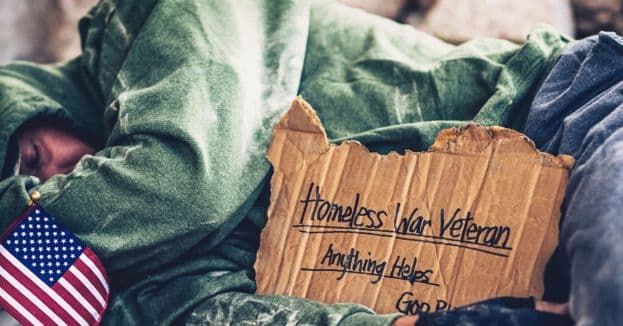
A sharp drop in veteran homelessness is expected this year, with analysts predicting the total number of homeless veterans could fall below 30,000 nationwide for the first time since federal tracking began.
Advertisement
after-intro
According to Hot Air, nonprofit group Community Solutions has released a preliminary analysis of 2026 point-in-time (PIT) data suggesting an 8.2% decline in veteran homelessness compared with 2025, the steepest drop in more than a decade. The projection, based on data from 182 of more than 380 HUD Continuum of Care regions, anticipates a national total between roughly 28,000 and 30,600 veterans, ahead of the U.S. Department of Housing and Urban Development’s official report due in January.
 Navy And Marine Corps Boards Quietly Defy Trump Transgender Ban—And Keep Warfighters In Uniform
Advertisement
inarticle
Community Solutions’ principal for policy and evaluation, Adam Ruege, told Military.com he is "very confident" in the group’s estimates, noting the dramatic shift since 2011. "I worked at the VA back then [in 2011], so I remember those days when there were like 75,000 veterans in the Point-in-Time count," he said. "We actually thought that was an undercount, right? To go from 75,000 to now below 30,000...something has happened, something has worked, right?"
Analysts modeled three scenarios for 246 communities that have not yet reported, all anchored to HUD’s 2025 baselines, with the “middle ground” estimate yielding the 8.2% national decline. "These are estimates, right? We actually don't know what the results will be," Ruege cautioned, while adding, "We've done this for the last three years and each year we actually come out pretty close, about one or two percentage points away from what the final count has been for veterans specifically."
Advertisement
inarticle
The data show that a handful of large jurisdictions are driving much of the progress, with Los Angeles alone reporting a roughly 25% drop in homeless veterans, though Community Solutions deliberately down-weighted that outlier to avoid overstating gains. "That's really weighing it too much," Ruege said, explaining that the model assumes other communities will more closely mirror prior-year trends, which is "where we land on 8% and so that's kind of a midpoint."
The report underscores how far the country has come since the early Obama years, when veterans were significantly more likely to be homeless than non-veterans and federal policy leaned heavily on expansive social programs. By 2022, that risk had flipped, with veteran status becoming a protective factor—progress driven not only by federal initiatives like HUD-VASH, but also by state and local partners that have focused on targeted, results-oriented interventions rather than open-ended spending.
"I think an important thing here is the continued investment and focus of the VA on these services," Ruege said, praising states that step in where Washington leaves gaps. "Places like New Jersey, which has made incredible progress on supporting unchecked veterans living out in the streets. Places like Minnesota and Maine have statewide organizations that help fill in gaps for veterans. ... This continued investment and focus on veteran homelessness actually led to the results that we're getting."
Ruege illustrated the change through the story of “Frank,” a Marine Corps veteran he met while doing street outreach in Columbus, Ohio, who refused to enter a shelter for years. "I came back to him every week and said, 'Frank, man, when are you ready? When are you ready to come inside?'" Ruege recalled, but "at the time, the only option we had was a shelter. ... I saw him for a couple of years, every week, and he never wanted to come inside because that wasn't the place for him."
Everything shifted when the HUD-VASH program allowed Ruege to offer Frank a permanent home instead of a cot in a shelter. "What changed for me, and what changed for the system, is when I could go out to Frank and say, 'Hey, Frank, I got a place for you to live now. I got a voucher for you, and let's go down to the public housing authority and get you signed up," he said, noting that Frank became the first veteran housed under HUD-VASH in Columbus and remained stably housed for years.
For conservatives who have long argued that targeted assistance, accountability, and local flexibility work better than sprawling federal bureaucracies, the veteran homelessness trend offers a powerful case study in what focused policy can achieve when it prioritizes outcomes over ideology. "For our organization and for so many of us who have worked in this, we are seeing results. ... We can help support telling the story. We believe that communities can do more," Ruege said, adding, "We do not want to let off the gas here because we do have a ways to go. It's amazing to see the progress that has been made, but we do have a ways to go."
Advertisement
article-bottom-1
Advertisement
article-bottom-2