HomeMilitary
Military
Military Boards Were Ordered To Discharge Transgender Troops — What Navy And Marine Panels Did Next Sparked A Clash
Advertisement
above-image
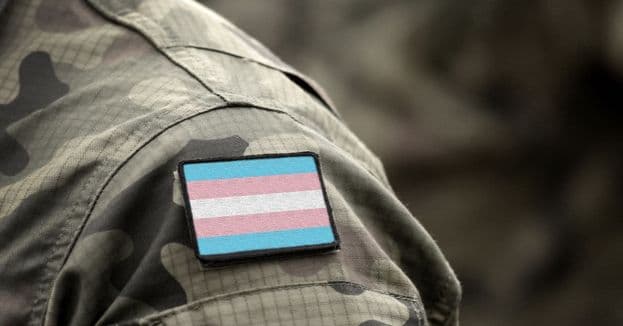
Military review boards in the Navy and Marine Corps are increasingly resisting the Biden Pentagon’s enforcement of President Donald Trump’s transgender service restrictions, voting in a majority of recent cases to retain transgender-identifying personnel despite explicit instructions to recommend discharge.
Advertisement
after-intro
According to Breitbart, review panels in the sea services have quietly diverged from the pattern seen in the Army and Air Force, where boards have largely followed Pentagon guidance to separate transgender-identifying troops. The outlet reported that Navy boards have voted to keep transgender sailors in seven of nine cases since hearings began in July, while Marine Corps boards have recommended retention in two of three cases convened since August.
 Hegseth Links Confucius Institutes To DEI ‘Cancer’—And Uses Federal Funding To Dismantle Their Campus Comeback
Advertisement
inarticle
These outcomes stand in sharp contrast to those in the Army, where roughly 50 hearings have produced discharge recommendations in all but about five cases. The Air Force has been even more rigid, with approximately six hearings resulting in recommendations for discharge in every known instance.
Under current Pentagon procedures, three-member separation boards are instructed to determine whether a service member has a history of gender dysphoria or evidence of transgender identification, and then to recommend separation if those criteria are met. The rules explicitly bar these panels from weighing a service member’s performance, specialized skills, combat experience, or deployment history when deciding whether to recommend discharge.
Despite those constraints, some Navy and Marine Corps boards have reportedly taken the extraordinary step of crossing out portions of their official findings and instead recommending that transgender-identifying personnel be retained. This quiet form of bureaucratic resistance suggests that at least some officers on these panels view the policy as fundamentally at odds with military fairness, unit cohesion, or basic common sense.
Advertisement
inarticle
The boards’ recommendations are not final and can be reversed by the civilian secretaries who oversee each branch, leaving ultimate authority in the hands of political appointees. The Pentagon has refused to release comprehensive data on the hearings, which are closed to the public, and Breitbart noted that its findings are based on interviews with affected service members and the attorneys representing them.
“These boards are being told to do something that they know is wrong — to rubber-stamp a non-choice given to them by the administration,” Rachel VanLandingham, a former Air Force attorney and now a professor at Southwestern Law School, told the paper. “We are seeing them say they’re not going to play that game. We are seeing them nullify a process they see as unjust.”
One of the most striking Marine Corps cases involved Staff Sgt. Damien Contreras, a supply and logistics specialist with roughly ten years of service and three overseas deployments. Contreras was placed on paid leave in April and later appeared before a separation board at Marine Corps Base Quantico in Virginia in late August.
During the hearing, a government attorney introduced 2017 documents showing that Contreras had changed genders, evidence that under Pentagon rules should have led to a straightforward recommendation for discharge. Instead, after reviewing his record and performance evaluations, the board crossed out language referencing “a history of cross sex hormone therapy,” checked the box indicating he “remains qualified,” and formally recommended that he be retained.
“You have war fighters looking at war fighters,” Contreras told the paper. “They see I’ve always done my job, I’ve deployed, I’ve mentored other Marines, followed the rules. They say, ‘Hey, this is a good Marine, why wouldn’t we retain him?'”
In another Marine Corps case, the board technically recommended discharge in line with Pentagon policy but added a unanimous notation that the service member should “be retained based on his commendable service record and unique skills.” That kind of written dissent, embedded in an official finding, underscores the tension between Washington’s directives and the judgment of officers closer to the operational realities of the force.
Priya Rashid, an attorney who has represented dozens of transgender-identifying service members, said that early in the process she lost nearly all of her cases, only to see a noticeable shift in outcomes over the summer. She suggested that the pattern of retention decisions in the Navy and Marine Corps may reflect a growing discomfort among board members with the rigidity of the policy.
“I don’t understand why this pattern is occurring,” Rashid told the newspaper. “And I’m worried that if the pattern becomes too apparent, the government will just change the processes and procedures again so that the pattern can be extinguished.”
Breitbart also highlighted the case of a Navy paramedic whose board recommended retention in July despite the Pentagon’s clear guidance to the contrary. The sailor, who had earned two merit-based promotions and served alongside Marines deployed to the southern border, said all three board members disclosed that they personally knew transgender individuals, including former colleagues and friends.
“I never ran into people who cared if I was trans,” the sailor said. “They just cared that I did my job well.”
His attorney, Steph Kral, later represented another sailor before a different Navy board, which likewise recommended retention even though its members reportedly lacked similar personal ties to transgender-identifying individuals. Kral argued that the boards’ decisions were less about ideology and more about preserving capability and fairness within the ranks.
“I don’t think they are trying to make any grand policy statement,” Kral said. “I think they’re just trying to do what’s best for the Navy.”
The report also noted a September address at Quantico by former Army officer and conservative commentator Pete Hegseth, who has been a vocal advocate for restoring traditional military standards and eliminating social experimentation from the ranks. In that speech, Hegseth called for a return to strict norms, declaring that the services should adopt standards of “No fatties. No trannies. No beardos. No weirdos. No wimps. No radicals.”
VanLandingham suggested that broader dissatisfaction with Pentagon leadership and its politicized priorities may be influencing some board members’ willingness to push back against the transgender policy. Rashid, by contrast, pointed to the Marine Corps’ intense culture of loyalty and mutual obligation as a key factor in the retention recommendations.
“The questions from the Marine boards have focused in on how the policies of higher-ups may have changed, but the Marines in question never did anything wrong,” Rashid said. “I think they are looking for a way to give a fellow Marine the benefit of the doubt.”
The individual military branches declined to discuss specific outcomes or make board members available for interviews, citing ongoing litigation surrounding the transgender service rules. The Defense Department likewise refused to comment, and Breitbart cautioned that the relatively small number of Navy and Marine Corps cases means the emerging pattern could shift as more hearings are held.
These boardroom skirmishes are unfolding against the backdrop of a years-long legal and political battle over whether the armed forces should be compelled to accommodate transgender-identifying personnel. In March 2025, Breitbart News reported that the U.S. Court of Appeals for the Ninth Circuit rejected the Trump administration’s request to enforce its transgender military ban while appealing a preliminary injunction issued by U.S. District Judge Benjamin Settle, in a case brought by Lambda Legal and the Human Rights Campaign Foundation on behalf of seven active-duty transgender service members.
In a separate case, U.S. District Judge Ana Reyes blocked the Pentagon from implementing its policy barring transgender troops from serving without a waiver, further constraining the administration’s ability to restore traditional standards. These legal challenges followed Trump’s January 27 executive order, which stated that “expressing a false ‘gender identity’ divergent from an individual’s sex cannot satisfy the rigorous standards necessary for military service,” and in February Hegseth directed the Pentagon to pause new accessions involving individuals with a history of gender dysphoria and medical procedures associated with gender transitions.
Despite judicial resistance, the administration made headway in 2025 after the Supreme Court intervened. In May 2025, Breitbart News reported that the Pentagon began removing more than 1,000 openly transgender-identifying personnel from immediate service after the Court granted the administration’s emergency request to lift a nationwide injunction blocking enforcement of its policy.
At the same time, the Pentagon gave other transgender-identifying service members 30 days to depart voluntarily and began combing medical records to identify personnel diagnosed with gender dysphoria or receiving related treatment. Defense officials reported that 4,240 troops across active-duty forces, the National Guard, and the reserves had been diagnosed with gender dysphoria as of December 9, 2024, though they acknowledged the true number could be higher.
Public opinion has generally favored Trump’s effort to restore biologically grounded standards in the military, despite intense opposition from progressive activists and much of the corporate media. A Rasmussen Reports survey of 1,325 likely voters conducted January 29–30 and February 2, 2025, found that 54 percent approved of Trump’s executive order, including 38 percent who strongly approved, while 41 percent disapproved, including 30 percent who strongly disapproved.
Yet the legal fight continued into 2026, with mixed results for the administration. In June 2026, Breitbart News reported that the U.S. Court of Appeals for the District of Columbia Circuit ruled 2–1 that 28 transgender-identifying individuals challenging the administration’s policy could continue serving while their lawsuit proceeded, a narrow decision that applied only to those plaintiffs and did not block restrictions on new enlistees.
Judge Robert L. Wilkins, writing for the majority, faulted the government for not substantiating its characterization of transgender service members, stating, “Indeed, the government has not contested that the Plaintiff-Appellees who are currently serving (and who have collectively earned more than 80 recommendations) have served honorably and pose no threat to national security.” That reasoning reflected a broader judicial trend of prioritizing individual service records and anti-discrimination norms over the executive branch’s traditional deference on military readiness and personnel standards.
On Capitol Hill, efforts to codify Trump’s policy into law have also faced resistance, even within the republican Party. In July 2026, Breitbart News reported that the House rejected an amendment to the National Defense Authorization Act sponsored by Rep. Lauren Boebert (R-CO) that would have written Trump’s transgender service ban into statute, with the measure failing 212–217 after four republicans joined Democrats in opposition: Reps. Brian Fitzpatrick (R-PA), Mike Lawler (R-NY), James Moylan of Guam, and Kimberlyn King-Hinds of the Northern Mariana Islands.
Moylan and King-Hinds, as nonvoting delegates, could vote on amendments but not on final passage of the bill, making their defections symbolically significant. “Four ‘republicans’ just betrayed President Trump and our military in favor of the Transgenders,” Boebert wrote on X. “DISGUSTING!”
Even as Boebert’s amendment failed, conservatives notched other victories in the same defense bill. Two amendments sponsored by Rep. Nancy Mace (R-SC) passed the House, including one prohibiting TRICARE from covering sex-change drugs and surgeries, which passed 219–208, and another barring transgender-identifying male students from girls’ K–12 sports teams at Department of Defense-operated schools, which passed 221–203.
The administration has continued to press its case in the courts, seeking to reassert executive authority over who may serve in uniform. On September 1, 2026, Breitbart News reported that the Trump administration filed an urgent appeal with the Supreme Court seeking permission to remove 29 transgender-identifying individuals from military service or the enlistment pipeline before their lawsuit proceeded to trial in January.
The case involved active-duty personnel, reservists, National Guard members, and one prospective enlistee, underscoring the breadth of the challenge to the administration’s policy. Solicitor General John Sauer described the lower court ruling that allowed the plaintiffs to remain in their positions as “gravely erroneous,” but for the time being the individuals were permitted to continue serving or advancing through the enlistment process while the case moved forward.
As the legal and political battles grind on, the quiet defiance emerging from some Navy and Marine Corps separation boards highlights a deeper struggle over the character and mission of the U.S. armed forces. While the administration and many conservatives argue that the military must prioritize combat effectiveness, biological reality, and clear standards over social experimentation, segments of the officer corps and the judiciary appear determined to preserve special protections for transgender-identifying personnel, even at the cost of undermining executive authority and unit cohesion.
Advertisement
article-bottom-1
Advertisement
article-bottom-2