HomeU.S
U.S
New York Slaps Amish Schools With $118,000 Vaccine Fines—And The Penalties Are Just Getting Started
Advertisement
above-image
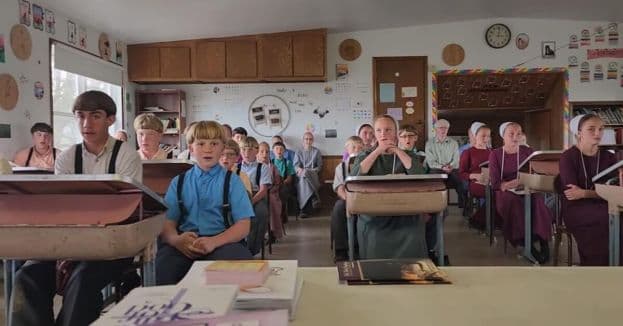
New York State has escalated its clash with religious liberty by levying $118,000 in fines against three Amish schools that enrolled children whose parents, for reasons of faith, refuse vaccination.
Advertisement
after-intro
According to The Gateway Pundit, the penalties were imposed on Dygert Road School, Twin Mountain School (also known as Pleasant View), and Shady Lane School, which serve Amish communities in Clymer, Heuvelton, and near Canajoharie. The Second Circuit opinion notes that the commissioner of health fined Dygert Road School $52,000, Twin Mountain $46,000, and Shady Lane $20,000, in a state that is home to roughly 25,000 Amish residents, the fifth-largest Amish population in the country.
 Navy And Marine Corps Boards Quietly Defy Trump Transgender Ban—And Keep Warfighters In Uniform
Advertisement
inarticle
At the heart of the dispute is New York Public Health Law § 2164, which mandates that any child attending public, private, or parochial school for more than 14 days must receive a slate of state-required vaccinations unless a valid medical exemption is granted. Each violation can trigger a fine of up to $2,000, and the Department of Health treats each day that an unvaccinated child is present in school as a separate, billable offense.
For Dygert Road and Twin Mountain, the Department of Health chose to assess the maximum penalty of $2,000 per unvaccinated student, counting one day of noncompliance for each child. Shady Lane, which did not provide student records, was fined on the assumption of one unvaccinated student attending for 10 days, and the commissioner characterized the resulting totals as “principled and conservative under the circumstances.”
Advertisement
inarticle
“That’s $2,000 per student per day,” said Aaron Siri, managing partner of Siri & Glimstad, which represents the Amish families in the case. “The state of New York has now told them… you want to stay in this state, you need to abandon your religious beliefs.”
For decades, New York recognized that religious convictions could justify exemptions from school vaccination mandates, allowing such exemptions from 1966 until June 13, 2019. That changed abruptly after the 2018–2019 measles outbreak, when the legislature repealed the religious exemption by a vote of 84–61 in the Assembly and 36–26 in the Senate, while leaving the medical exemption intact.
The Department of Health audited the three Amish schools in November and December 2021, scrutinizing their compliance with the revised statute. By March 2022, the department had formally charged them with allowing students to attend beyond the 14-day grace period without certificates of immunization or valid medical exemptions, effectively criminalizing the schools’ longstanding religious practice.
Following an administrative hearing, the commissioner of health upheld the charges and imposed the six-figure fines, despite the hearing judge’s recommendation against financial penalties. The judge had cited inadequate notice to the schools, but the department rejected that reasoning and pressed ahead with the sanctions.
The Amish schools do not require proof of vaccination because the parents’ religious beliefs explicitly forbid it, and those beliefs are not casual preferences but deeply held theological convictions. According to the complaint, the families regard abortion as murder and believe vaccine development is linked to aborted fetuses, and they maintain that educating their children together in their own schools is integral to their religious formation, such that the fines threaten to shut down institutions they see as extensions of their church.
In filings quoted by Amish America, parents described the schools as church-run, one-room parochial institutions that accept no state aid and operate entirely within the Amish community. “The Amish want to be able to practice their religion in peace in New York,” Siri said, emphasizing the continuity of their way of life, adding, “They want to continue engaging in the manner that they have lived for almost 200 years in New York. These are small one-room classrooms. Amish buildings on Amish land with Amish teachers. All paid for by the Amish.”
“Even over $100,000 is far too much to ask the Amish to pay,” Siri said, underscoring the disproportionate impact of the fines on a modest, agrarian community. “The state of New York knows that. They are intent on having the Amish abandon their beliefs or leave New York.”
Attorneys for the families argue that the Amish simply cannot pay the fines without liquidating land and other essential assets, a step that would destabilize their communities and way of life. If they lose their case, they say, the families will relocate to Pennsylvania, a neighboring state that still allows religious exemptions from school vaccination requirements and has historically been more respectful of religious minorities.
The families filed suit against New York on June 2, 2023, asserting that the vaccination law, as applied to them, violates their rights under the First and Fourteenth Amendments, as well as the parental rights recognized in the landmark 1972 Supreme Court case Wisconsin v. Yoder. In Yoder, the Court held that Amish parents could withdraw their children from formal schooling after eighth grade, recognizing the unique role of Amish education in preserving their religious community.
The U.S. District Court for the Western District of New York dismissed the Amish families’ case, and the Second Circuit affirmed that dismissal in March 2025, siding with the state’s public health rationale. But in December 2025, the Supreme Court vacated the Second Circuit’s ruling and remanded the case for reconsideration in light of Mahmoud v. Taylor, a 2025 decision in which the Court held that parents could opt their children out of school instruction that conflicted with their religious beliefs.
On June 30, 2026, however, the Second Circuit again ruled against the Amish families, drawing a sharp distinction between curriculum content and health mandates. The court held that the vaccination requirement does not regulate what children are taught and therefore does not impose the type of burden on religious education at issue in Yoder or Mahmoud, even though Alabama and 19 other states filed a brief supporting the Amish and warning of the implications for religious liberty nationwide.
Undeterred, on September 28, 2026, First Liberty Institute, Siri & Glimstad, Lehotsky Keller Cohn, and attorney Chris Wiest filed a new petition for certiorari with the Supreme Court. The case was docketed as No. 26-438 on October 2, and New York’s response is due November 2, setting the stage for a potential high-court showdown over the scope of the Free Exercise Clause.
The petition asks the Supreme Court to decide whether New York’s vaccination law violates the Free Exercise Clause as applied to the Amish and whether the Court should reconsider Employment Division v. Smith, the 1990 decision that allowed neutral, generally applicable laws to burden religious practice without strict scrutiny. Many religious liberty advocates have long criticized Smith as giving government too much leeway to trample faith-based objections under the guise of neutrality.
The Department of Health told Fox News Digital it could not comment on pending litigation, declining to address the specific hardships imposed on the Amish families. It instead issued a generic statement that the state’s school immunization requirements are based in science and designed to protect the health of all New Yorkers, a familiar refrain that sidesteps the constitutional and moral questions at stake.
On paper, it might appear that New York is effectively telling the Amish they may continue practicing their religion so long as they pay a crippling fine, but even that is not the actual arrangement. Paying the $118,000 would not allow unvaccinated children to remain in school, because the Department of Health counts each day each unvaccinated student attends as a separate violation, ensuring that fines will continue to mount as long as the families remain faithful to their beliefs.
The current fines cover only the 2021 audit period, calculated at one day per student for Dygert Road and Twin Mountain and one student for 10 days for Shady Lane, according to the Second Circuit opinion. Under Public Health Law § 12, each violation carries a penalty of up to $2,000, rising to $5,000 for a repeat violation within 12 months, meaning that as long as the schools stay open and the children remain unvaccinated, the financial pressure will intensify relentlessly.
Just as with COVID-era mandates, one can argue that a policy being “based in science” does not automatically make it morally defensible or even rational when the cost-benefit ratio is honestly weighed. Locking all children in separate dungeons would indeed reduce disease transmission to 0%, for example, but no sane society would accept such a policy given the catastrophic human suffering it would cause, and from a moral and religious standpoint, it seems deeply wrong for government to coerce people into violating their conscience.
Moreover, the Amish have historically avoided vaccination and yet have not experienced the kind of catastrophic, community-wide mortality that would justify treating their stance as a public health emergency. If the state is genuinely worried about contagion, it must also acknowledge that the Amish largely remain within their own communities, and just as with COVID masks and vaccines, if people outside those communities are vaccinated and believe in the protection vaccines offer, they should not fear the vaccination status of people with whom they rarely, if ever, interact.
The broader context in New York only heightens the sense of double standard and ideological bias. While the state aggressively penalizes a small, self-sufficient community of U.S. citizens who generally do not accept state money, run their own schools, and simply want to be left alone, it simultaneously extends protections and benefits to large numbers of illegal aliens, a population with a high rate of dependence on public assistance and whose members are, by definition, in violation of immigration and employment laws through illegal presence, illegal entry, illegal work, or related criminal activity.
The primary difference is not public health risk but cultural and religious identity: the Amish are Christian, traditional, and self-governing, and for many on the left, that combination appears intolerable. In targeting the Amish with escalating fines while shielding illegal immigrants from serious consequences, New York sends a clear message about whose values it respects and whose beliefs it is willing to crush, reinforcing the perception that modern liberal governance reserves its harshest treatment for those who cling to faith, family, and local autonomy.
Advertisement
article-bottom-1
Advertisement
article-bottom-2